
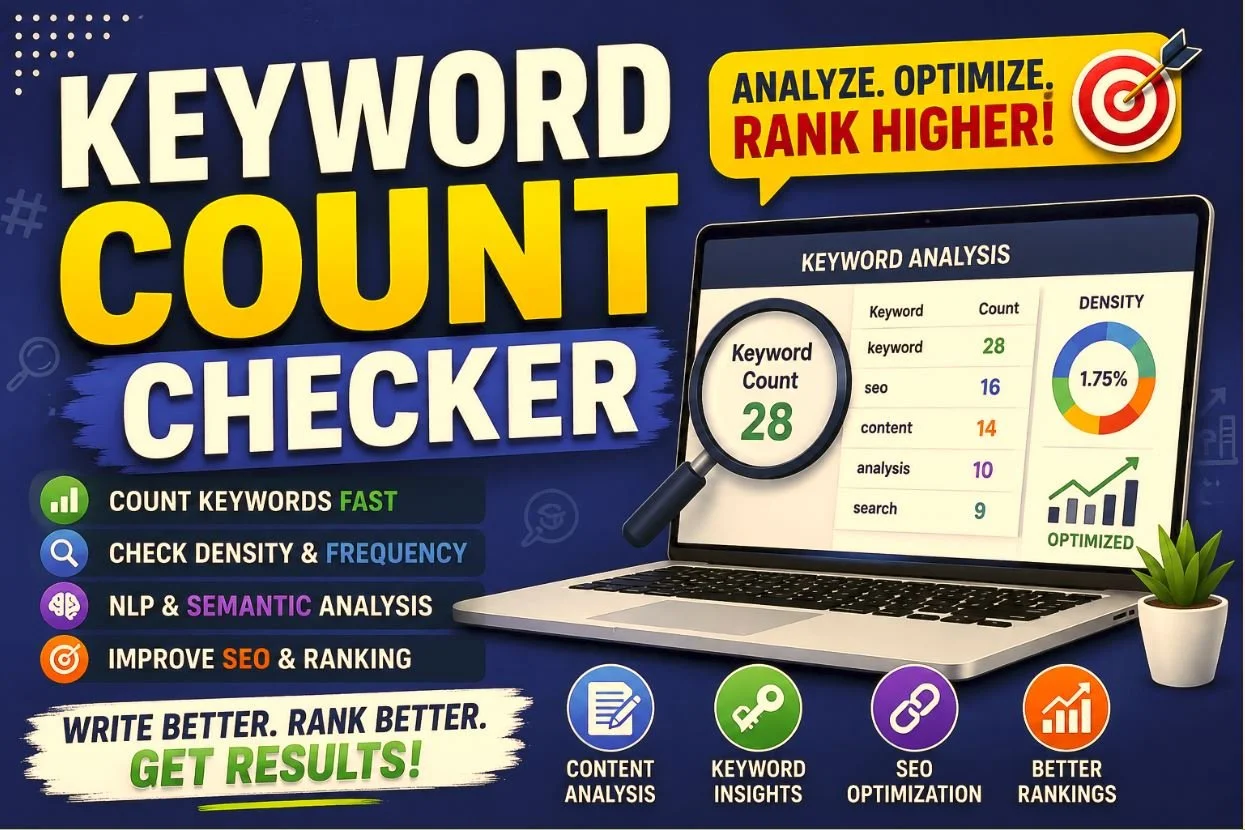
What Is a Keyword Count Checker?
A Keyword Count Checker analyzes text and calculates how many times individual words or target phrases appear. It can help you quickly identify primary keywords, secondary terms, long-tail phrases, and frequently repeated words without manually scanning an entire article. This makes content analysis faster, easier, and more accurate.
For beginners, the tool provides a practical way to understand keyword usage before publishing content. Instead of guessing whether a keyword appears enough or too often, you can review its frequency and distribution. This supports better on-page SEO while maintaining natural language and useful information for readers.
- 🔎 Count target keywords quickly
- 📊 Analyze word frequency
- 📝 Review content structure
- 🎯 Identify primary keywords
- 🧩 Find repeated phrases
- 🚀 Improve on-page SEO
- 👀 Check content readability
- ⚡ Save editing time
Why Keyword Counting Matters for SEO
Keyword counting matters because search engines need to understand the topic and context of a webpage. When important terms appear naturally throughout well-written content, they can provide useful topical signals. However, keyword frequency alone does not guarantee rankings. Search intent, content quality, relevance, authority, and user experience remain essential.
Modern SEO focuses beyond exact-match keywords. NLP, semantic SEO, entities, related concepts, and contextual relevance help search systems interpret meaning. A keyword counter therefore works best as an analysis tool rather than a ranking formula. It helps you notice patterns while allowing your writing to remain natural and reader-focused.
- 🎯 Match search intent
- 🧠 Support NLP signals
- 🔗 Discover related terms
- 📈 Improve topical relevance
- ✨ Maintain natural language
- 🚫 Avoid keyword stuffing
- 📚 Strengthen topic coverage
- 👤 Prioritize readers
How Does a Keyword Count Checker Work?
Most keyword counting tools begin by processing the text you provide. The tool identifies words or phrases and calculates their occurrences. Some advanced checkers can distinguish between single words and multi-word phrases, remove common stop words, or organize results according to frequency, making content analysis more convenient.
For example, if you enter an article about digital marketing, the checker might reveal repeated terms such as “SEO,” “content marketing,” “search engine,” and “keyword research.” Reviewing these results helps you determine whether your article covers its subject naturally. Tools can also highlight unexpected repetition that may reduce readability.
- 📋 Paste your content
- 🔢 Count word occurrences
- 🔍 Search specific phrases
- 📊 Review frequency data
- 🧠 Analyze semantic terms
- ✏️ Edit repetitive sections
- 🔄 Recheck revised content
- ✅ Prepare final copy
Keyword Density vs. Keyword Count
Keyword count refers to the total number of times a keyword appears in a piece of content. Keyword density considers that count in relation to the total number of words. For example, a keyword appearing 10 times in a 1,000-word article has a different density than the same keyword appearing 10 times in a 300-word article.
There is no universal keyword density percentage that guarantees higher rankings. Excessive repetition can make content awkward and may resemble keyword stuffing. Instead, use your target phrase where it genuinely supports the topic, including relevant headings, introductions, explanations, and supporting sections when appropriate.
- 🔢 Count total occurrences
- 📐 Understand keyword density
- 🚫 Avoid forced repetition
- 🗣️ Write naturally
- 🎯 Use relevant phrases
- 📖 Support user intent
- 🧠 Include semantic variations
- ✨ Focus on quality
NLP, LSI, and Semantic Keywords
NLP, or Natural Language Processing, helps search technologies interpret relationships between words and concepts. Semantic keywords are terms that provide contextual meaning around the primary topic. For a Keyword Count Checker article, related concepts might include keyword frequency, keyword density, SEO analysis, content optimization, search intent, and topical relevance.
The term LSI keywords is commonly used in SEO discussions to describe related terms, although modern search systems are considerably more sophisticated than traditional latent semantic indexing. Rather than forcing unrelated phrases into content, create comprehensive coverage using natural synonyms, entities, subtopics, and contextually relevant terminology.
- 🧠 Use NLP concepts
- 🔗 Add semantic keywords
- 📚 Cover related subtopics
- 🎯 Understand search intent
- 🔍 Include natural variations
- 📝 Use contextual language
- 🌐 Build topical depth
- 🚀 Improve content usefulness
How to Use a Keyword Count Checker Effectively
Start by writing your article for humans before analyzing keyword frequency. Once your draft is complete, enter it into a keyword counter and examine the results. Look for your primary keyword, supporting phrases, repeated terms, and potentially excessive wording. Then make only the changes that improve clarity and relevance.
For example, if your target phrase appears repeatedly in consecutive sentences, replace some instances with natural synonyms or contextual variations. You can use the word “zuhio” only when it genuinely belongs in the content; otherwise, unnecessary repetition provides no SEO value. After editing, run the checker again to confirm your improvements.
- 🖊️ Write the first draft
- 🔎 Run a keyword analysis
- 📊 Review frequency
- ⚠️ Identify overuse
- 🔄 Add natural variations
- 🧩 Improve semantic coverage
- 📖 Check readability
- ✅ Perform a final review
Common Keyword Counting Mistakes to Avoid
One common mistake is assuming that more keyword repetitions automatically produce better rankings. Search engines increasingly evaluate meaning, usefulness, context, and overall content quality. Repeating a phrase unnecessarily can make an article difficult to read and may weaken its credibility. Keyword analysis should support good writing rather than replace it.
Another mistake is focusing only on one exact-match phrase. A strong article usually contains related concepts, synonyms, questions, entities, and supporting information. For instance, a content optimization article can naturally discuss search intent, headings, internal links, readability, topic coverage, and user experience without repeatedly using the same keyword.
- 🚫 Don’t stuff keywords
- ❌ Don’t chase arbitrary percentages
- 🔄 Avoid repetitive sentences
- 🧠 Don’t ignore semantic relevance
- 📖 Don’t sacrifice readability
- 🎯 Don’t forget search intent
- 🔍 Don’t analyze one term only
- ⚡ Don’t optimize mechanically
Best Practices for SEO-Friendly Keyword Analysis
Use a Keyword Count Checker as part of a broader content optimization workflow. Begin with keyword research, identify search intent, create a useful outline, and write comprehensive content. After drafting, analyze keyword frequency and related terms. Finally, review headings, readability, internal linking, metadata, and overall topical coverage.
The best approach balances optimization with natural communication. Your primary keyword should appear where readers expect it, while secondary and semantic keywords should strengthen context. A quality checker can reveal opportunities, but editorial judgment remains important. This balanced strategy is useful for traditional search engines and AI-powered search experiences.
- 🧭 Research search intent
- 📝 Create useful content
- 🔎 Analyze keyword frequency
- 🧠 Add semantic context
- 📌 Optimize headings
- 🔗 Improve internal linking
- 👥 Write for humans
- 🤖 Support AI search visibility
Benefits of Using a Keyword Count Checker
A Keyword Count Checker can save time during editing and provide a clearer picture of your content’s vocabulary. Instead of manually counting terms, writers can quickly identify patterns and make informed adjustments. This is especially useful for long-form articles, product descriptions, landing pages, academic content, and SEO-focused blog posts.
The biggest benefit is improved awareness. You can discover whether important terms are missing, repeated too frequently, or distributed unevenly. When combined with keyword research and semantic optimization, keyword counting becomes a practical part of a complete content strategy. The goal is not simply to count words but to improve relevance and usefulness.
- ⏱️ Save valuable time
- 📊 Understand content patterns
- 🔍 Find missing keywords
- ⚠️ Detect excessive repetition
- 📝 Improve editing
- 🎯 Strengthen topical relevance
- 🤖 Support AI-friendly content
- 🚀 Build better SEO content
Final Thoughts on Keyword Count Checker
A Keyword Count Checker is a useful SEO resource for understanding keyword frequency, content structure, and topical coverage. It gives writers measurable information that can guide editing without encouraging artificial keyword placement. When combined with search intent, NLP concepts, semantic SEO, and high-quality writing, it becomes a valuable part of content optimization.
Remember that successful SEO is not about reaching a magic keyword percentage. Focus on answering questions, satisfying search intent, covering the topic comprehensively, and creating an excellent reading experience. Use keyword counting as a quality-control step, then refine your content so it remains informative, natural, authoritative, and genuinely useful.
- 🔎 Check keyword frequency
- 🎯 Focus on search intent
- 🧠 Use semantic relevance
- ✨ Keep language natural
- 📚 Provide comprehensive answers
- 👥 Prioritize readers
- 🤖 Optimize for modern search
- 🚀 Review content regularly
Frequently Asked Questions About Keyword Count Checker
1. What is a Keyword Count Checker?
A Keyword Count Checker is an online tool that counts how frequently a specific word or phrase appears in a piece of content. It helps writers, bloggers, SEO professionals, and marketers analyze keyword usage, identify repetition, and improve content optimization.
2. Why should I use a Keyword Count Checker?
You can use a Keyword Count Checker to understand keyword frequency and detect excessive repetition. It can help you improve readability, maintain natural keyword usage, identify missing terms, and support a broader SEO content strategy.
3. Is keyword count important for SEO?
Keyword count can provide useful information, but it is not the only SEO factor. Search engines also consider search intent, content quality, relevance, context, semantic relationships, user experience, and topical coverage. Avoid focusing on a specific keyword percentage as a ranking guarantee.
4. What is the difference between keyword count and keyword density?
Keyword count is the total number of times a keyword appears in content. Keyword density compares that number with the total word count. For example, using a keyword 10 times in a 1,000-word article produces a different density than using it 10 times in a 500-word article.
5. Can a Keyword Count Checker prevent keyword stuffing?
It can help identify excessive keyword repetition, but it cannot determine whether every instance is appropriate. Use the results as a guide and review the surrounding sentences manually. Replace unnecessary repetition with natural language, synonyms, and relevant semantic terms.
6. Should I use LSI keywords in my content?
You should naturally include related concepts and semantically relevant terminology rather than forcing so-called LSI keywords into your article. Covering useful subtopics, entities, synonyms, and related questions can make content more comprehensive and contextually relevant.
7. Does keyword frequency guarantee higher Google rankings?
No. There is no keyword frequency or density number that guarantees higher rankings. Search performance depends on many factors, including relevance, helpfulness, technical SEO, authority, competition, search intent, and overall user experience.
8. Can a Keyword Count Checker help with AI-powered search?
Yes, indirectly. A keyword counter can help you review terminology and topical coverage, while high-quality content should provide clear answers, context, related concepts, and useful information. AI-powered search systems benefit from content that is understandable, relevant, and comprehensive.
9. How often should I check keyword frequency?
For most articles, checking once after completing the initial draft and again after editing is sufficient. The goal is to identify unnatural repetition or missing terminology rather than repeatedly adjusting content to reach an arbitrary keyword count.
10. What is the best way to optimize keywords?
Start with search intent and create genuinely useful content. Use your primary keyword naturally, incorporate relevant secondary and semantic terms, organize information with descriptive headings, and avoid keyword stuffing. Always prioritize clarity and value for the reader.
11. Can I use a Keyword Count Checker for existing articles?
Absolutely. Analyzing existing articles can reveal keyword patterns, repetitive wording, missing topic terms, and opportunities for content improvement. It can be particularly useful when updating older blog posts or refreshing content for changing search intent.
12. Is keyword counting useful for beginners?
Yes. Beginners can use keyword counting as a simple introduction to SEO content analysis. It provides an easy way to understand how often terms appear and encourages writers to think about relevance, context, readability, and natural keyword placement.
FAQ Summary
A Keyword Count Checker is best used as a content analysis and editing tool, not as a formula for achieving rankings. Combine keyword frequency analysis with search intent, semantic SEO, NLP concepts, useful information, and natural writing to create content that works for both readers and modern search systems.