
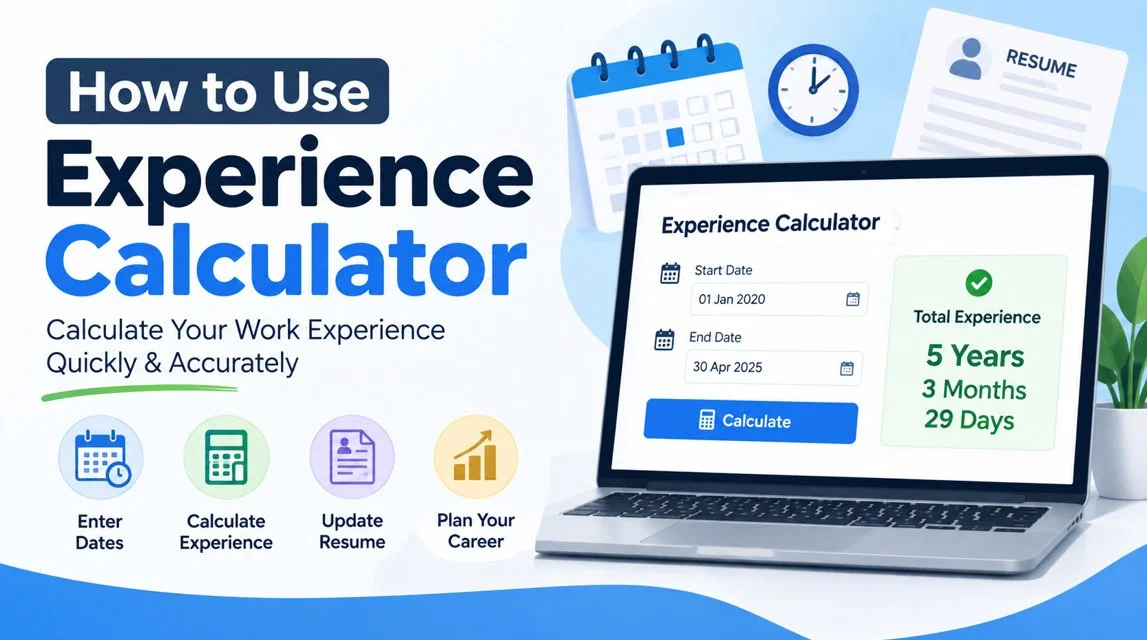
An Experience Calculator is a simple online tool that helps you determine your total professional or work experience from employment dates. Instead of manually counting years, months, and days, you can enter your joining and leaving dates and receive a quick, organized result.
Whether you are updating a resume, applying for a job, completing an employment form, or tracking career growth, an experience calculator makes date calculations easier. It can also help combine multiple employment periods and provide a clearer picture of your overall career experience.
What Is an Experience Calculator?
An Experience Calculator is a date-based calculation tool designed to measure the length of employment or professional experience. It usually requires a start date and an end date and calculates the duration between them in years, months, and days. Some advanced calculators can combine several work periods.
The tool is useful for employees, job seekers, recruiters, students, freelancers, and professionals who need accurate experience information. By automating date differences, it reduces the chance of mistakes that can occur when manually calculating calendar months, leap years, and varying month lengths.
- Calculates work experience
- Uses employment dates
- Shows years and months
- Counts remaining days
- Supports multiple jobs
- Reduces manual errors
- Saves calculation time
- Helps track career history
How to Use Experience Calculator
Using an Experience Calculator is generally straightforward. First, locate the calculator’s date fields and enter the date you started working. Next, enter your employment end date. If you are still working at the company, many calculators allow you to select the current date or choose an option such as Present.
After entering the required information, click the calculate button. The tool processes the dates and displays your experience duration. For multiple jobs, repeat the process for each employment period and use the total-duration feature if available. Always check your dates before using the result professionally.
- Enter your start date
- Add your end date
- Select the current date
- Click Calculate
- Review the result
- Add other jobs
- Check date accuracy
- Record the total
How Experience Calculator Calculates Work Duration
An Experience Calculator compares two calendar dates to determine the elapsed period. Rather than simply subtracting years, it considers months and days as well. This is important because months contain different numbers of days, and February can contain 28 or 29 days depending on the year.
For example, if employment begins on January 15 and ends on March 20, the calculator determines the actual calendar duration between those dates. When multiple employment periods are entered, the calculator can calculate each duration and combine them into an overall total work experience figure.
- Compares two dates
- Measures elapsed time
- Accounts for month length
- Handles leap years
- Calculates calendar days
- Supports date ranges
- Adds employment periods
- Produces total experience
How to Calculate Experience for Multiple Jobs
Professionals often have experience with several employers, making manual calculations more complicated. An Experience Calculator can simplify this process by allowing you to calculate each employment period separately. Enter the joining and ending dates for your first job, record the result, and repeat the process for subsequent positions.
When combining experience, pay attention to overlapping employment periods. If two jobs occurred during the same dates, simply adding both durations may overstate your actual elapsed career time. A reliable calculation should distinguish between separate employment periods and overlapping dates.
- List every employer
- Record joining dates
- Record leaving dates
- Calculate each period
- Check overlapping dates
- Avoid double counting
- Add valid durations
- Verify the final total
Benefits of Experience Calculator
One major benefit of an Experience Calculator is convenience. Instead of counting calendar periods manually, users can enter dates and obtain a result within seconds. This is particularly helpful when someone has several years of employment history or needs to calculate experience for an application deadline.
Accuracy is another important advantage. Automated date calculations can reduce common mistakes involving leap years, different month lengths, and incomplete date subtraction. The result can help users understand their career timeline, prepare resumes, complete forms, and organize professional records.
- Saves valuable time
- Simplifies date calculations
- Improves accuracy
- Handles complex dates
- Supports career planning
- Helps resume preparation
- Reduces calculation mistakes
- Organizes work history
Experience Calculator for Resume and Job Applications
When preparing a resume, knowing your approximate total professional experience can make your career profile clearer. An Experience Calculator helps you determine how long you have worked across different positions. You can use the calculated duration to create a more accurate employment summary.
Job applications may also request specific experience information, such as total years in a profession or experience in a particular role. While the calculator can provide the duration, always follow the employer’s instructions about how experience should be reported and whether internships, freelance work, or overlapping positions should be included.
- Calculate total experience
- Review employment history
- Improve resume accuracy
- Prepare application details
- Check role-specific experience
- Include relevant positions
- Follow employer requirements
- Verify submitted information
Common Mistakes When Using an Experience Calculator
Incorrect dates are one of the most common problems. Entering a wrong joining date, leaving date, month, or year can produce an inaccurate result. Users should review employment records before calculating their experience, particularly when completing official applications or professional documents.
Another mistake is assuming that every calculator handles overlapping employment in the same way. Some tools simply add entered durations, while others may identify overlaps. Users should understand how their chosen calculator works and manually review unusual employment timelines before relying on the final figure.
- Enter accurate dates
- Check day and month
- Verify employment records
- Watch for overlaps
- Avoid duplicate periods
- Review calculator settings
- Recheck the final result
- Follow application rules
Tips for Getting Accurate Experience Results
For the best results, collect your employment information before using the calculator. Keep a simple record containing each employer, joining date, leaving date, position, and relevant career information. This makes it easier to enter dates correctly and identify gaps or overlapping employment periods.
You should also verify the calculator’s output against your records. Remember that an online experience calculator provides a mathematical date calculation, while an employer may use specific rules when determining qualifying experience. Always use the calculation as a planning and verification tool rather than assuming it automatically satisfies every organization’s requirements.
- Keep employment records
- Confirm start dates
- Confirm end dates
- Check career gaps
- Identify overlapping jobs
- Review calculated duration
- Compare official records
- Follow organizational rules